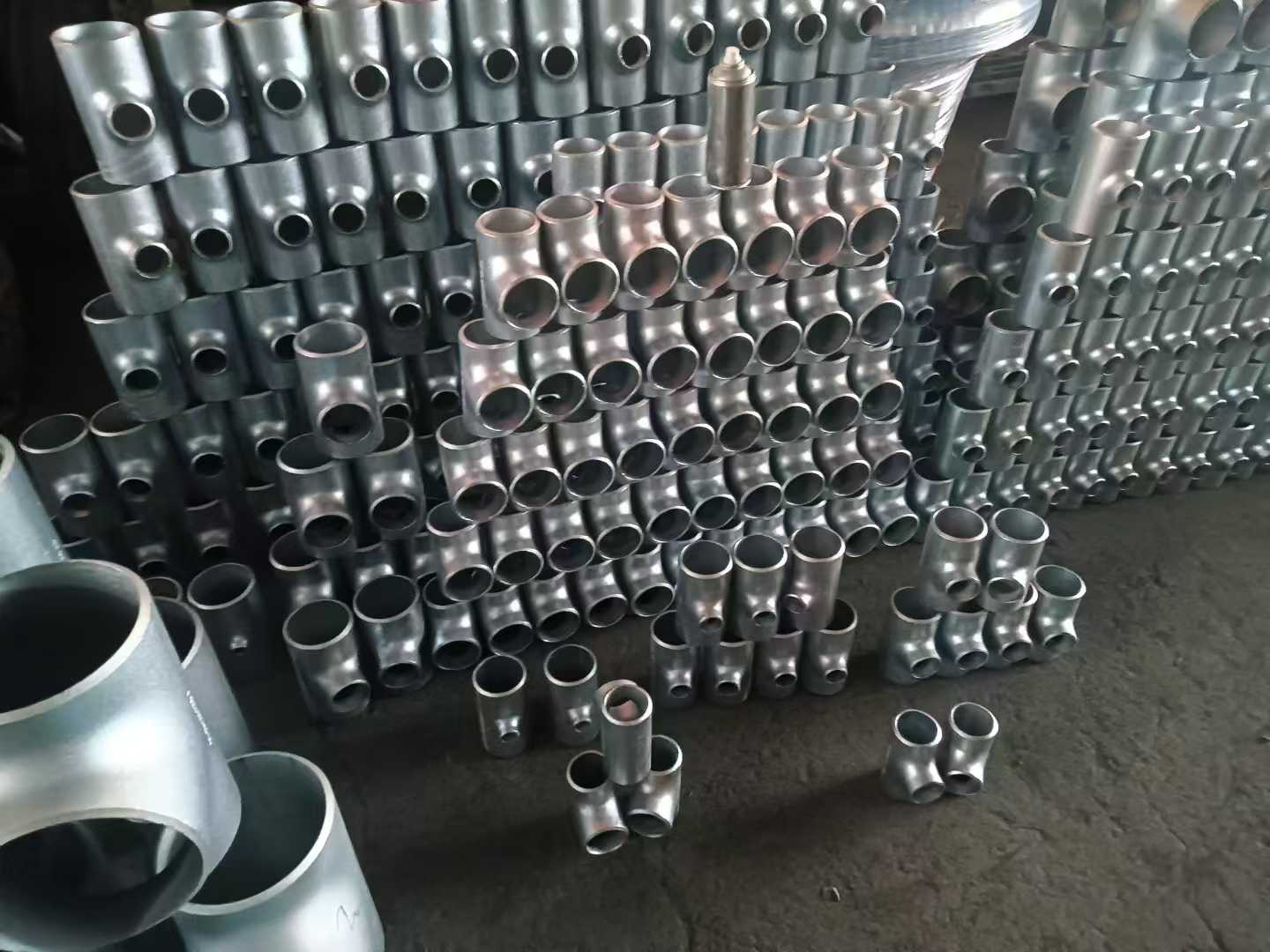
What is a pipe tee and which type do you need?
A pipe tee creates a branch from a run pipe. It is specified by the run size, the branch size, the connection method, the schedule and the material. When the branch is smaller than the run it is a reducing tee; when both are equal it is an equal tee.
The manufacturing method matters as much as the dimensions: a tee can be extruded from seamless pipe, fabricated by welding a branch onto a run, or forged. Each has a different pressure capability and a different inspection story.
Equal tee, reducing tee, or a fabricated branch connection?
| Option | Description | When to use |
|---|---|---|
| Equal tee | Branch size equals run size | Full-size branches, headers and manifolds |
| Reducing tee | Branch is one or more sizes smaller | The usual case for instrument, drain and small process branches |
| Weld-on branch (olet) | A reinforced boss welded to the run pipe | Small branches where a full tee is uneconomic |
| Fabricated tee | Branch welded into a run pipe | Large sizes outside standard fitting ranges |
For small branches, a weld-on olet is often cheaper and structurally adequate. For full-size or high-pressure branches, an extruded or forged tee is the correct choice.
What affects the pressure rating of a tee?
- Wall thickness and schedule — the tee must match the run pipe schedule.
- Manufacturing method — an extruded tee retains continuous grain flow, which is why it performs better in cyclic and high-pressure service than a fabricated one.
- Material grade — and whether impact testing is required for low temperature.
- Inspection — the branch junction is a stress concentration, so the acceptance criteria for weld and heat treatment are more demanding than for a straight fitting.
How to specify a tee
- Run size and branch size, both stated explicitly.
- Schedule or wall thickness for run and branch.
- Standard, typically ASME B16.9 for butt weld fittings.
- Material grade and any supplementary testing.
- Whether the branch is full size or reducing, and the centre-to-end dimensions if non-standard.
- Documentation requirement — EN 10204 3.1 and third-party inspection where specified.
Frequently asked questions
Can a reducing tee be replaced by a tee plus a reducer?
It can, but it adds a weld and a fitting, which increases cost and the number of potential leak paths. Where the size difference is one or two sizes, a reducing tee is the normal choice.
What is the difference between an equal tee and a cross?
A cross has branches on both sides of the run, so it has two branch connections instead of one. It is used where two branches leave the same point.
Is an extruded tee stronger than a fabricated tee?
Generally yes, because the branch is formed from the run material rather than welded on, so the grain structure is continuous around the junction. For high-pressure or cyclic service this is the reason extruded tees are specified.
Tee size and material range
| Item | Range |
|---|---|
| Butt-weld tees (GB/T 12459, ASME B16.9) | DN15 – DN1200 (NPS 1/2″ – 48″) |
| Socket-weld and threaded tees (ASME B16.11) | DN6 – DN100 (NPS 1/8″ – 4″) |
| Configuration | Equal tee, reducing tee; branch sizes down to several steps below the run |
| Wall thickness | SCH40, SCH80, SCH160, XXS, or nominal wall to specification |
Material selection for tees
| Service | Typical grade |
|---|---|
| Flue gas, air, water up to 425 °C | 20#, A234 WPB |
| RTO and high-temperature ductwork | 321 (A403 WP321), Q355B for large fabricated branches |
| Cooling and glycol loops | 304L / 316L |
| Seawater, high chloride, sour service | 2205 / 2507 duplex |
| High-temperature steam and hydrogen | 15CrMo (WP11), 12Cr1MoV (WP22) |
| Severe acid and wet chlorine | Hastelloy C-276, Inconel 625 |
Stock size bands follow the same logic as elbows: DN15–DN50 for small-bore and liquid cooling, DN65–DN300 for main process and RTO ductwork, DN350–DN1200 for main flue ducts and headers.
Custom tee manufacturing
When a branch is not a catalogue size, we make the tee to the drawing – unequal branches, non-standard run length, special branch angle, or a large fabricated body that cannot be produced from a seamless fitting.
- Unequal and non-standard branches – any run x branch combination, including side-inlet arrangements
- Special angles – 45 deg, 60 deg and project-specific branch angles
- Fabricated bodies – for large diameters where a seamless tee is not available in the required size or schedule
- Material options – A234 WPB, A403 stainless, alloy steel, low-temperature grades
- OEM marking and documents – size stamps, heat numbers, EN 10204 3.1 certificate
Send your drawing or specification and we will confirm what can be made before quoting. Request a made-to-order quotation · info@pipingfitting.com.
PipingFitting.com is a leading pipe tee manufacturer, producing equal tees, reducing tees, and side inlet tees for industrial piping systems. Our tees are made from carbon steel, stainless steel, and alloy steel, manufactured to ASME B16.9, ASME B16.28, DIN, and JIS standards. We supply tees for oil & gas, petrochemical, power, marine, and general industrial applications worldwide.
Equal Tee
An equal tee has three openings of the same diameter, with the branch outlet perpendicular to the run. It is the most common tee type, used for dividing or combining flow in a piping system. Equal tees are available in butt weld (ASME B16.9), socket weld (ASME B16.11), and threaded (ASME B16.11) connections. Standard sizes range from 1/2″ to 24″ NPS.
Reducing Tee
A reducing tee has a branch outlet of a different size than the run openings. This allows connection of a smaller branch line to a larger main pipeline without requiring an additional reducer. Reducing tees are commonly used in instrument taps, sample lines, and drainage connections. The branch size reduction follows standard ratios per ASME B16.9.
Tee Types by Manufacturing Method
- Butt Weld Tees: Wrought steel tees per ASME B16.9, produced by piloting or rotary forging. Most common for high-pressure industrial piping.
- Socket Weld Tees: Forged steel tees per ASME B16.11, for small bore high-pressure services (NPS 2″ and below).
- Threaded Tees: Forged steel tees with NPT/BSP threads, for low-pressure and instrument applications.
- Seamless Tees: Produced from seamless pipe, no weld seam, highest structural integrity for critical services.
- Welded Tees: Fabricated from plate or pipe with a weld seam, cost-effective for large diameter and low-pressure applications.
Tee Materials
- Carbon Steel: A234 WPB, A420 WPL6 (low temp), Q235, Q345, 10#, 20#, 16Mn
- Stainless Steel: A403 WP304, WP304L, WP316, WP316L, WP321, WP310S
- Alloy Steel: A234 WP11 (1.25Cr), WP22 (2.25Cr), WP5 (5Cr), WP91 (9Cr-1Mo)
- Special Alloys: Duplex 2205, Super Duplex 2507, Monel 400, Inconel 625 (on request)
Tee Standards
- ASME B16.9 — Wrought Steel Butt-Welding Fittings (most common)
- ASME B16.28 — Wrought Steel Butt-Welding Short Radius Return Bends and Tees
- ASME B16.11 — Forged Steel Fittings, Socket-Welding and Threaded
- DIN 2615 / EN 10253 — European butt weld tees
- JIS B2312 — Japanese steel pipe tees
- GB/T 13401 — Chinese national standard for steel butt weld fittings
Applications
Pipe tees are fundamental components in every piping system: crude oil and product pipelines, refinery and petrochemical process piping, power plant feedwater and steam systems, marine and offshore piping, HVAC distribution networks, water and wastewater treatment plants, and industrial gas systems. Proper tee selection ensures balanced flow distribution and system reliability.
Quality Assurance
Manufactured under ISO 9001 certification. Each order includes Mill Test Certificate (MTC) per EN 10204 Type 3.1. Available dimensions covered by pressure classes from 150# to 2500#. Third-party inspection by SGS, BV, or as requested. Surface treatment: anti-rust oil, black painting, or as specified.
Request a Tee Quote
Send us: tee type (equal/reducing), material grade, size (run × branch), schedule/wall thickness, standard, quantity, and delivery requirement. We provide a detailed quotation within 24 hours.
Email: info@pipingfitting.com | WhatsApp: +86 19833770783 | WeChat: 18301170098
Types of Pipe Tees
Butt weld tees come in five configurations: equal (straight) tee – all three ends the same size; reducing tee – smaller branch, ordered run x run x branch; lateral (Y-tee) – 45° branch for merging flows gently; barred tee – internal bars preventing pig passage into the branch (pigging lines); and the cross (4-way tee) – four outlets at one point. All per ASME B16.9 in A234 WPB carbon steel (“black pipe tee”) and A403 stainless grades.
3-Way and 4-Way Tee Connectors
A standard tee is a 3-way connector: run in, run out, branch out. Add a second branch and it becomes a 4-way connector – the cross. Crosses appear on headers distributing to two opposite branches (sprinkler risers, manifold takeoffs) and on equalizing lines. They cost more than tees (four weld ends, center reinforcement) and are ordered by NPS x NPS (all four ends equal) or with reducing outlets. We manufacture crosses to order – send size and schedule.
Water & Plumbing System Tees
For industrial water systems – cooling headers, firewater rings, pump station manifolds – carbon steel welding tees are the durable choice: full-penetration welds never loosen or leak the way threaded fittings can under vibration. (Household plumbing uses copper/PVC/PEX tees – a different trade.) For plant plumbing-adjacent service, our tees weld to standard NPS pipe with matching schedules. Full tee types guide →