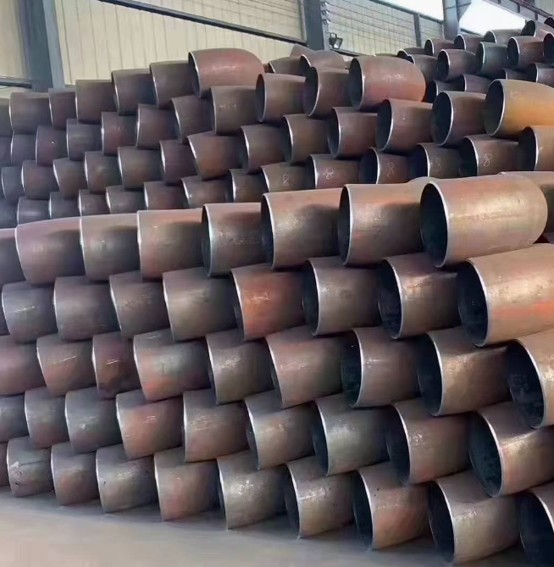
What is a pipe elbow and how is it specified?
A pipe elbow changes the direction of a pipeline. It is specified by the angle (45 or 90 degrees, with other angles made to order), the radius (long or short), the connection method (butt weld, socket weld, threaded), the nominal size, the wall thickness or schedule, and the material grade.
The elbow is one of the highest-stress fittings in a line, because the change of direction concentrates thrust and bending. That is why the radius and the wall thickness are engineering decisions, not purchasing preferences.
Long radius or short radius?
| Dimension | Long radius (LR, 1.5D) | Short radius (SR, 1.0D) |
|---|---|---|
| Centre to face | 1.5 times nominal diameter | 1.0 times nominal diameter |
| Pressure loss | Lower | Higher |
| Flow disturbance | Less | More |
| Space required | More | Less |
| Typical use | Default for most process lines; pigging and where pressure drop matters | Congested areas, and where the line can tolerate the higher loss |
Long radius is the default in most process piping because it reduces pressure drop and erosion. Short radius is chosen when space is the binding constraint.
45 degrees or 90 degrees?
A 90 degree elbow turns the line through a right angle and produces the largest local pressure loss. A 45 degree elbow turns through half that angle and is often used in pairs when a gentler direction change is wanted, or when the routing needs an offset rather than a corner. Using two 45s instead of one 90 reduces pressure loss but uses more space and adds a weld.
Connection methods and wall thickness
- Butt weld — the standard for process piping above about 2 inch; the fitting ends are bevelled and matched to the pipe schedule.
- Socket weld — small bore, high pressure; the pipe inserts into a socket and is fillet welded.
- Threaded — small bore utility lines; limited by pressure and by the risk of thread leakage in cyclic service.
- Wall thickness — expressed as schedule (SCH 40, 80, 160, XXS) or as a nominal wall; the fitting must match the pipe, otherwise the internal bore steps and creates turbulence and a weld mismatch.
How to specify an elbow
- Nominal size and the matching pipe schedule.
- Angle and radius — for example “90 degree long radius”.
- Standard, typically ASME B16.9 for butt weld fittings.
- Material grade and any impact or hardness requirement.
- End preparation and whether the ends are bevelled or plain.
- Documentation — EN 10204 3.1 and any third-party inspection.
Common mistakes
- Specifying the angle but not the radius, so the centre-to-face dimension is wrong for the isometric.
- Mismatching the fitting schedule to the pipe schedule, which leaves an internal step.
- Using short radius in a line where pressure drop was calculated on long radius.
- Ignoring the material’s low-temperature impact requirement on cold service.
Frequently asked questions
What does 1.5D mean on a long radius elbow?
It means the centre-to-face dimension is 1.5 times the nominal pipe diameter. A 4 inch long radius 90 degree elbow therefore has a centre-to-face of 6 inches.
Can elbows be made to a non-standard angle?
Yes. Non-standard angles are produced to order, but they are not covered by the standard dimensional tables, so the drawing must specify the angle and the centre-to-face dimension.
Why does the fitting schedule have to match the pipe?
Because a mismatch creates an internal step at the weld. That step disturbs flow, can trap product, and complicates radiographic interpretation of the joint.
Elbow size and material range
| Item | Range |
|---|---|
| Butt-weld elbows (GB/T 12459, ASME B16.9) | DN15 – DN1200 (NPS 1/2″ – 48″); DN1400 and DN1600 available to order (MSS SP-75) |
| Socket-weld and threaded elbows (ASME B16.11) | DN6 – DN100 (NPS 1/8″ – 4″); not normally made above DN150 |
| Angles | 45°, 90°, 180° (return); other angles to drawing |
| Wall thickness | SCH40, SCH80, SCH160, XXS, or nominal wall to specification |
Size bands by application
- Small bore — DN15 to DN50: liquid cooling, instrument and sample lines
- Main process — DN65 to DN300: RTO and VOC ductwork, oil and gas, vapour recovery
- Large bore — DN350 to DN1200: main flue ducts and headers
Material selection for elbows
| Service | Typical grade |
|---|---|
| Flue gas and air up to 425 °C | 20#, A234 WPB |
| RTO hot section, 450–600 °C | 321 (A403 WP321) |
| Glycol and cooling water loops | 304L or 316L (A403 WP304L / WP316L) |
| Chloride-bearing or sour service | 2205 duplex (A815 WPS32205) |
| Low temperature to −46 °C | A420 WPL6 / A350 LF2 |
| High-temperature steam and hydrogen | 15CrMo (WP11), 12Cr1MoV (WP22) |
The end preparation must match the pipe: a butt-weld elbow is bevelled to the pipe schedule, and a mismatch leaves an internal step at the weld.
Specify an elbow for your piping layout
Send the piping isometric or a marked drawing with your elbow inquiry. A nominal pipe size alone does not identify the bend geometry, weld-end dimensions or material required for a replacement or a new line.
| Order detail | What to provide |
|---|---|
| Direction and radius | State the angle and long-radius or short-radius requirement. For a drawing-specific bend, include the required radius and tangent lengths. |
| Pipe connection | Provide nominal size, pipe outside diameter and wall thickness at each weld end. Include the required end preparation. |
| Material and manufacture | Identify the material specification and grade, seamless or welded requirement, and any project restrictions. |
| Dimensions and acceptance | Name the dimensional standard and edition required by the project. Identify the dimensions, tolerances and inspection records to be checked. |
Before you order
Before approving a replacement, compare the center-to-end dimensions and available installation space with the existing line. Do not substitute a different radius solely because the nominal size matches.
What should I send for a replacement elbow?
Send the existing marking, photographs, a dimensioned sketch, pipe size and wall thickness, material requirement, quantity and service conditions. Highlight any dimension that cannot change.
Related products and references
Request a quotation — send your specification, quantity and drawing to info@pipingfitting.com.
Custom elbow manufacturing
Not every change of direction is a 45 deg or 90 deg fitting. We make elbows to order in special angles, non-standard radii and fabricated segmented forms for large diameters.
- Special angles – 22.5 deg, 30 deg, 60 deg and drawing-specific angles
- Non-standard radius – long radius, short radius, 3D and 5D bends to suit the line
- Mitred (segmented) bends – fabricated bends for large diameters where a standard elbow is not available
- Material options – A234 WPB, A403 stainless, alloy steel, low-temperature grades
- OEM marking and documents – heat numbers, dimensional report, EN 10204 3.1 certificate
Send your drawing or specification and we will confirm what can be made before quoting. Request a made-to-order quotation · info@pipingfitting.com.
1. Product Introduction
steel Pipe elbow is a key pipe fitting used to change pipeline flow direction at 45°, 90°, 180° or custom angles in piping systems. Widely connected via welding, threading or flanged ends to straight pipes for industrial fluid conveyance.
Common Main Types
- 90° Elbow: Most common, right-angle pipeline turning
- 45° Elbow: Gentle turn for low flow resistance
- 180° Degree Pipe Elbows(Return Bend): U-shaped reverse pipeline turnaround
- Long Radius (LR) Elbow: R=1.5D, preferred for low pressure & smooth fluid flow
- Short Radius (SR) Elbow: R=1D, compact layout for limited installation space
2. Executive Standards
- ASME B16.9 (seamless & welded butt-weld elbows, inch size)
- EN 10253 / DIN 2605 (European metric standard)
- GB/T 12459, GB/T 13401 (Chinese national standard)
- MSS SP-75
3. Main Materials
Carbon Steel: A234 WPB, Q235, P245GH
Stainless Steel: A403 WP304 / 316L
Alloy Steel: WP11, WP22
Alloy & plastic customized material available
4. Size & Pressure Range
- Nominal Size: 1/2″ ~ 48″ (ASME), DN15 ~ DN1200 (EN/GB)
- Pressure Class: Class150~Class2500, PN6~PN160
End connection: Butt Weld(BW), Threaded(NPT/BSP), Socket Weld(SW), Flanged
5. Application Scope
- Oil & gas, petrochemical industry piping
- Water treatment, HVAC, fire protection pipeline
- Power plant, chemical corrosive medium delivery
- Food & pharmaceutical stainless steel pipeline
Our factory custom manufactures various steel pipe elbows per drawing & standard, welcome OEM & customized orders.
Choosing Between 45°, 90° and 180° Elbows
Route the line first: 90° elbows for right-angle turns, 45° elbows for offsets and gentle alignment, 180° returns for heater and exchanger passes. Radius: LR (1.5D) default, SR (1D) only where space forces it – see the LR vs SR guide.
All elbows are ASME B16.9, seamless 1/2″-24″, welded to 48″, SCH10-SCH160, A234 WPB / A420 WPL6 / A403 stainless. Dimension tables: ASME B16.9 dimensions.
Steel Pipe Elbows – Material Options
“Steel pipe elbow” covers several material families, and choosing right starts with the media: carbon steel (A234 WPB – the standard “black pipe” elbow for water, oil, gas, steam) is the default; stainless steel (A403 WP304/304L/316/316L) for corrosive and sanitary lines; low- alloy WP11/WP22 for high-temperature steam; A420 WPL6 for sub-zero service. All are weldable, all ship heat-number traceable. If your search started from “metal pipe elbow” or “black pipe elbow” – those are trade names within this same family: black refers to the dark oxide scale on uncoated carbon steel.
Pipe Bends vs Pipe Elbows
A bend is made by bending pipe (radius typically 3D-5D or greater); an elbow is a formed fitting with standardized radius (1D or 1.5D). Bends suit pigging lines and abrasive slurries (gentler flow); elbows suit standard routing where compact standardized geometry matters. We supply both – induction bends to order, B16.9 elbows from stock.
Note: PVC, copper and aluminum elbows serve plumbing and HVAC trades outside our steel range – we manufacture welded steel fittings for industrial systems.